
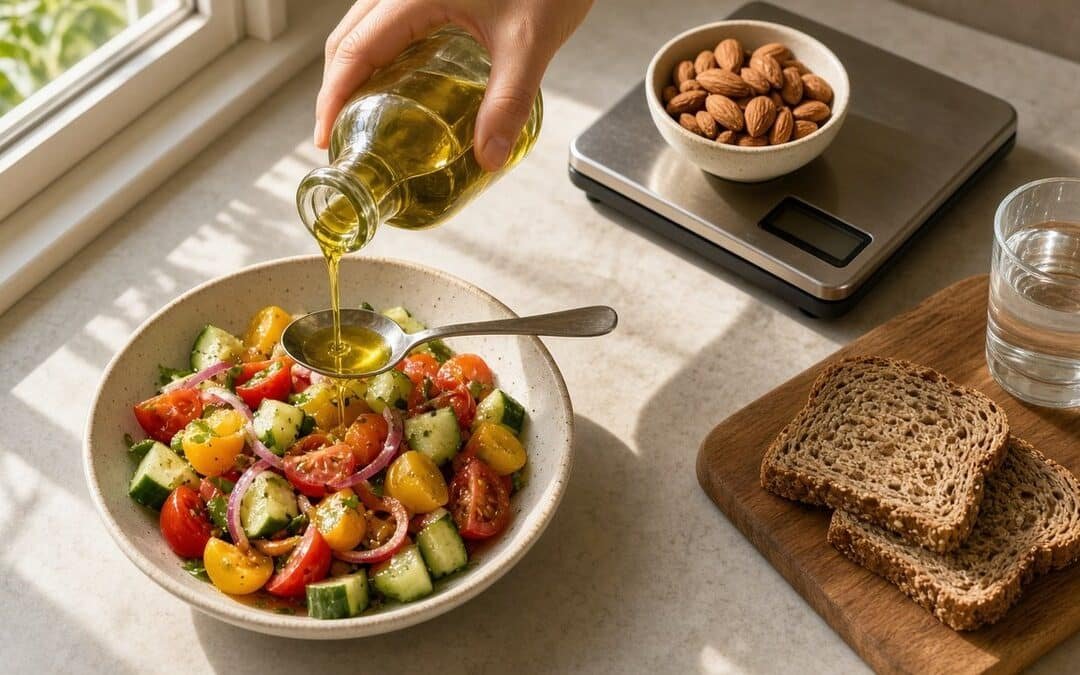
You have stuck with the Mediterranean way of eating for weeks: fish, salads, olive oil. The scale was moving. Now it has not budged for two weeks. A Mediterranean diet plateau is rarely about willpower. More often, a few healthy but energy-dense foods add up, while your body needs a little less fuel than when you started.

What causes a Mediterranean diet plateau?
A Mediterranean diet plateau usually has two causes. As you lose weight, your body burns fewer calories than it did at the start, and energy-dense healthy foods such as olive oil, nuts, bread, cheese and wine add up faster than they look. Measuring those foods for one week, then adjusting, is the most practical first step.
Key takeaways
- A plateau is common and does not mean the diet has failed.
- Healthy foods still carry energy: one tablespoon of olive oil is roughly 550 kJ (130 kcal).
- Generous extras, not “bad” foods, are the usual culprits.
- Most of us misjudge portions, so measure before you cut.
- One steady change at a time beats crash dieting.
Want portion-aware meal plans and recipes that help you move past a Mediterranean diet plateau without cutting the foods you enjoy?
Why am I not losing weight on the Mediterranean diet?
If you are wondering why you are not losing weight on the Mediterranean diet, you are not alone. It is normal. Mayo Clinic (United States) explains that the quick early drop is partly water, released as the body burns stored glycogen (Mayo Clinic Staff, 2024) [1]. As you lose weight you also lose some muscle, so metabolism slows. When the calories you burn equal those you eat, the scale stops.
The same page notes the approach that got you this far may maintain your new weight without taking more off. It suggests checking food and activity records for rules that have loosened: larger portions, more processed food or less exercise [1].
Mediterranean foods are good for you, so it is tempting to treat them as free. That is where a plateau tends to hide: not in biscuits you gave up, but in olive oil, nuts and bread that feel virtuous.
What are the 7 hidden calorie traps?
Energy is in kilojoules (kJ) or calories (kcal); 1 kcal is about 4.2 kJ. Serve sizes below come from Eat for Health (Australian Government) [4] [5], and olive oil from United States food data [6].
| Food | Standard serve | Approximate energy |
|---|---|---|
| Olive oil | 15 g (about 1 tablespoon) | 550 kJ (130 kcal) |
| Nuts | 30 g (about 1 oz) | 500-600 kJ (120-145 kcal) |
| Bread | 1 slice, 40 g (1.4 oz) | 500 kJ (120 kcal) |
| Hard cheese | 40 g (1.4 oz) | 500-600 kJ (120-145 kcal) |
| Wine | 200 mL (about 7 fl oz) | 600 kJ (145 kcal) |
| Honey or jam | 60 g (about 2 oz) | 600 kJ (145 kcal) |
Trap 1: Free-pouring olive oil
Olive oil is almost pure fat. United States data list it at 884 kcal per 100 g (FoodData Central, 2019) [6], so a 15 g pour is about 130 kcal. A salad poured from the bottle can carry two or three tablespoons. Pouring oil freely? olive oil for beginners guide shows easy ways to cook with less.
Trap 2: Nuts by the handful
One 30 g serve of nuts is about 500-600 kJ (Eat for Health, n.d.) [4]. Nuts are higher in kilojoules than many foods, so watch them when losing weight. From a big bag, two or three serves vanish unnoticed: portion into small containers.
Trap 3: The bread basket
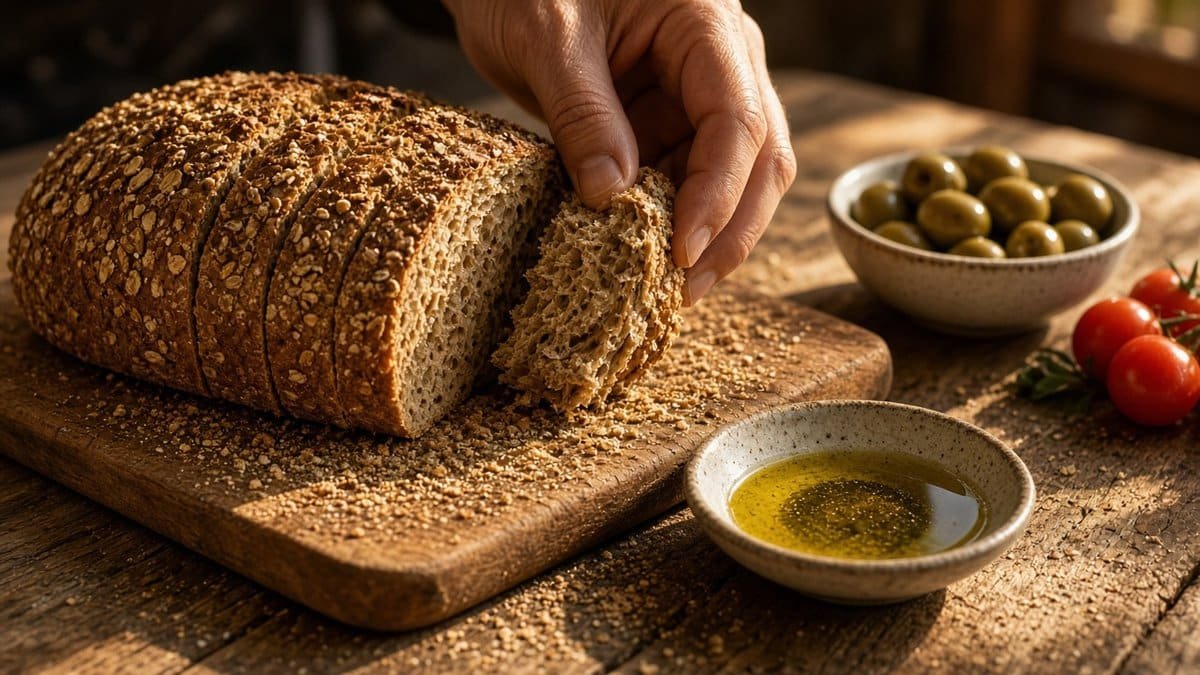
A 40 g slice of bread is one grain serve at around 500 kJ [4]. Three slices mopping up oil add about 1,500 kJ before the main. Enjoy one slice, and fill the rest of the plate with vegetables and legumes.
Trap 4: A glass (or two) of wine
Wine suits the picture, but 200 mL is two standard drinks and about 600 kJ, often one large glass (Eat for Health, n.d.) [5]. The guide classes alcohol as discretionary and says people aiming to lose weight do better if they minimise it.
Trap 5: Cheese and yoghurt creep
A 40 g piece of hard cheese is one serve at 500-600 kJ, and so is 200 g of yoghurt [4]. A generous sprinkle of feta over every salad passes 40 g quickly: weigh it once to learn a serve.
Trap 6: Honey, jam and dried fruit
Eat for Health counts 60 g of honey or jam as about 600 kJ [5] and lists dried fruit (30 g) as occasional. A medium fresh fruit, about 150 g, is roughly 350 kJ [4], a better everyday dessert.
Trap 7: Eyeballing everything
In a United States study, ten people who said they could not lose weight on under 1,200 kcal a day under-reported food by 47 percent on average and over-reported activity by 51 percent, while energy use was within 5 percent of predicted values (Lichtman et al., 1992) [2]. It was a small study, so treat it as a reminder: most of us misjudge portions.
Add it up. One pour of oil, a serve of nuts, two slices of bread and a large glass of wine come to roughly 2,700 kJ (about 650 kcal). None is junk food, but all of it counts, and that is how a plateau settles in.
Does this diet guarantee weight loss?
Not on its own. In the Predimed trial in Spain, 7,447 older adults with type 2 diabetes or three or more cardiovascular risk factors followed a Mediterranean diet with extra olive oil or nuts, or a lower-fat control diet, without an energy cut or exercise push. After a median of 4.8 years, bodyweight dipped only marginally in all groups, with no significant difference between Mediterranean arms and control (Estruch et al., 2019) [3].
The researchers support not restricting healthy fats for weight maintenance. Losing more weight still needs a modest energy gap from eating less or moving more (Mayo Clinic) [1]. Need a sensible energy gap? how to lose weight safely with a Mediterranean diet explains how to set one.
Ready for measured serves, weekly menus and reports that make losing weight on the Mediterranean diet simpler day to day?
5 easy tips to get past a diet plateau

- Measure for one week. Weigh your oil, nuts, bread and cheese, and jot it down. Struggling with portions? portion control without calorie counting shows a simple plate method.
- Dress with flavour, not volume. Measure the oil, then add lemon, garlic, herbs or vinegar for taste.
- Trim one extra. Choose the bread basket or the second glass of wine, not both.
- Fill up on vegetables. Eat for Health suggests filling up on leafy greens and other lower kilojoule vegetables when trying to lose weight [4].
- Move a little more. Mayo Clinic suggests at least 150 minutes of moderate aerobic activity a week, plus strength work such as weights to build muscle [1].
Weigh yourself at the same time once a week, because water shifts the scale from day to day. Wondering which fats help satiety? healthy fats that keep you full breaks them down.
My honest take: a Mediterranean diet not working on the scale rarely means the diet has failed. Losing weight on the Mediterranean diet often stalls when needs, portions or routine have shifted. Measure first, change one thing, give it a few weeks, and keep the habits that serve your heart and your enjoyment of food. If you want meal plans and recipes that make measured portions easier, my Mediterranean diet eBook brings them together.
Prefer a personalised Mediterranean plan with reports and recipes for US$27?
Frequently asked questions
Why am I not losing weight on the Mediterranean diet?
Usually because healthy but energy-dense foods (oil, nuts, bread, wine) add up, or your body now needs fewer calories than when you started. Measure portions for a week before you cut more foods.
How long does a Mediterranean diet plateau last?
There is no fixed length. A plateau usually ends when the energy you eat and burn changes, so what you adjust matters more than waiting.
Should I cut olive oil out completely?
No. Predimed supports not restricting healthy fats for weight maintenance. Measuring portions is gentler than removing the oil. Ask your doctor or dietitian what suits you.
Do I have to give up wine?
Not necessarily. Eat for Health suggests minimising alcohol if you want to lose weight, and 200 mL of wine is about 600 kJ. A smaller pour, or fewer drinking days, is one option.
Should I drop below 1,200 calories to break the plateau?
Mayo Clinic suggests not going below 1,200 calories a day, because fewer may not stop constant hunger, which raises your risk of overeating. Trim the hidden extras first, and talk with your doctor before cutting further.
Will more exercise help me get past a plateau?
It can. Mayo Clinic suggests at least 150 minutes of moderate aerobic activity a week, and at least 300 minutes for greater benefit, plus muscle-building exercise. Start gently and check with your doctor if you have a health condition.
This article is general information, not medical advice. Please talk with your doctor or an accredited dietitian before changing your diet, especially if you have a health condition.
References
All sources were opened and checked on 5 October 2026.
- Mayo Clinic Staff (2024). Getting past a weight-loss plateau. Mayo Clinic, United States. mayoclinic.org
- Lichtman S et al. (1992). Discrepancy between self-reported and actual caloric intake and exercise in obese subjects. New England Journal of Medicine 327(27):1893-1898, United States. pubmed.ncbi.nlm.nih.gov/1454084
- Estruch R et al. (2019). Effect of a high-fat Mediterranean diet on bodyweight and waist circumference: a prespecified secondary outcomes analysis of the Predimed randomised controlled trial. Lancet Diabetes & Endocrinology 7(5):e6-e17, Spain. pubmed.ncbi.nlm.nih.gov/31003626
- Eat for Health, Australian Government (n.d.). Serve sizes. Australia. eatforhealth.gov.au
- Eat for Health, Australian Government (n.d.). Discretionary food and drink choices. Australia. eatforhealth.gov.au
- United States Department of Agriculture (2019). FoodData Central: Oil, olive, salad or cooking, record 171413. United States. fdc.nal.usda.gov
Get well and stay well,
Ray Baker
