
By Ray Baker
Here is a small surprise: in 1993 the Harvard School of Public Health, Oldways Preservation and Exchange Trust, and the European Office of the World Health Organization introduced the Mediterranean Diet Pyramid, yet it does not specify portion sizes or specific amounts [1]. That is exactly why so many readers over 50 type Mediterranean diet us news and world report into a search box, hoping for a clear verdict. The useful answer is not a single ranking. It is a pattern you can adapt to your budget, your appetite and your kitchen. I want to walk you through what that actually means, without the hype.
What is Mediterranean diet us news and world report?
That search phrase usually means you are asking whether this way of eating is worth following. I cannot quote a ranking that is not in the sources, but the key point is the pattern: mainly fruits and vegetables, beans, nuts, whole grains, fish, olive oil, and small amounts of dairy [1]. This is general information, not medical advice.
Key takeaways
- This is a primarily plant-based eating plan, not a strictly regimented diet plan, and it does not specify portion sizes or specific amounts [1].
- Olive oil is recommended as the primary added fat [1].
- Fish and seafood are the preferred animal protein, with fish chosen at least twice weekly [1].
- Red meat is limited to a few times per month, while poultry, eggs, and dairy (cheese or yogurt) appear in smaller portions either daily or a few times a week [1].
- The pyramid also highlighted daily exercise and the beneficial social aspects of eating meals together [1].

What foods sit at the centre of the plate?
The Mediterranean diet includes daily intake of whole grains, olive oil, fruits, vegetables, beans and other legumes, nuts, herbs, and spices [1]. Extra virgin olive oil is the main source of fat, and you eat a good amount of fish, especially fish rich in omega-3 fatty acids [2]. The pyramid shape suggests the proportion of foods to eat, for example eat more fruits and vegetables and less dairy foods [1]. Fill the trolley from those lower layers first and the rest tends to follow. For a simple start, think of a warm cannellini bean and tomato bowl with a slice of whole-grain bread and a spoon of olive oil. It is filling, cheap and easy to repeat. The traditional diets of countries bordering the Mediterranean Sea differ slightly so there are different versions of the Mediterranean diet [1]. You eat a good amount of whole grains, like whole-wheat bread and brown rice, along with lots of vegetables, fruit, beans, lentils and nuts [2]. Sweets, sugary drinks and butter are foods to keep to little or none [2].
For a simple weekly structure, you can read the easy Mediterranean diet meal plan for beginners, which aligns with the Mediterranean diet us news and world report.

How often should fish, dairy and red meat appear?
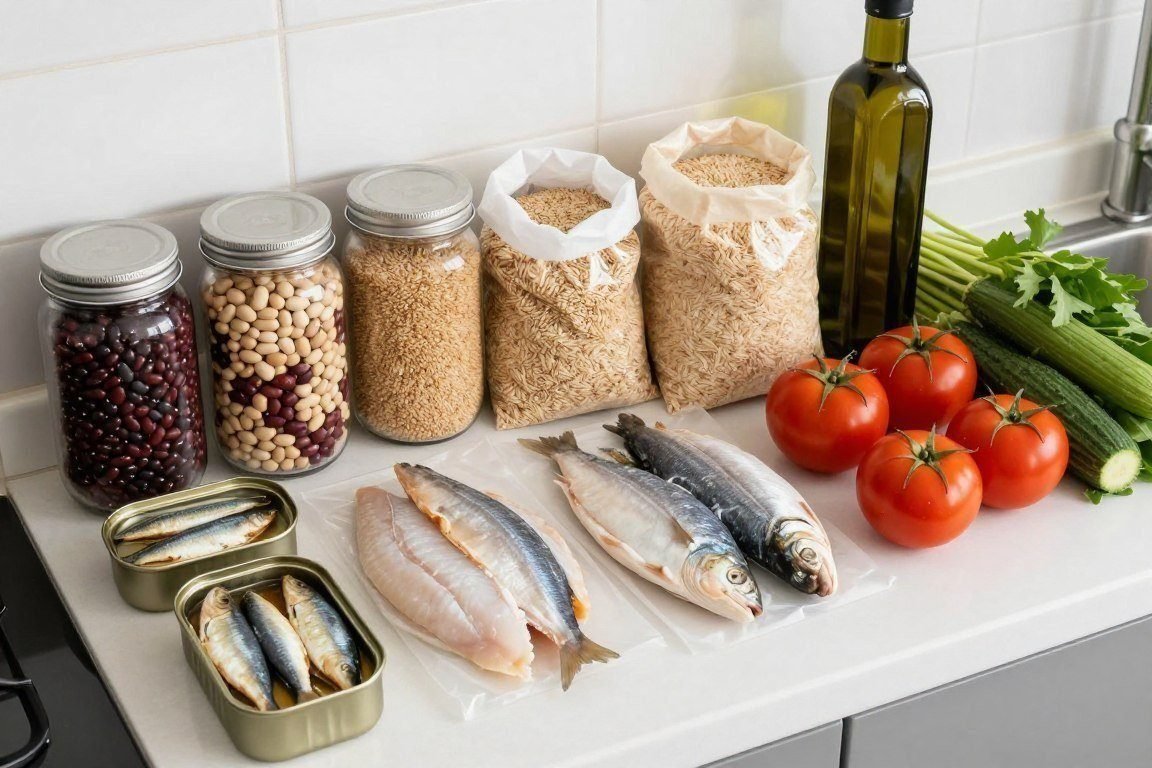
Fish and seafood are the preferred animal protein, and the guide is to choose fish at least twice weekly [1]. Poultry, eggs and dairy (cheese or yogurt) can appear in smaller portions either daily or several times a week [1]. Red meat is limited to several times per month [1]. I see plenty of people over 50 worry about seafood cost, but frozen white fish, tinned sardines and canned salmon do the job without a big bill. If red meat is a habit, swap one or two evening meals a week for beans or lentils first, then add fish as your budget allows. A dietitian can help you modify your approach as needed based on your medical history, underlying conditions, allergies and preferences [2]. Herbs and spices are part of the daily intake in this eating plan [1].
Why does olive oil get so much attention?
This pattern does not treat olive oil as a garnish. The Mediterranean diet recommends it as the primary added fat, replacing other oils and fats (butter, margarine) [1]. Among these foods, walnuts and fish are high in omega-3 fatty acids [1]. Other foods naturally containing healthful fats are highlighted, such as avocados, nuts, and oily fish like salmon and sardines [1]. The extra virgin variety is the main source of fat [2]. Researchers have linked these eating patterns with a reduced risk of coronary artery disease (CAD) [2]. One meta-analysis reviewed prospective cohort studies that analysed the relation between adherence to a Mediterranean diet, mortality, and incidence of chronic diseases [3], and observational cohort studies plus a secondary prevention trial have shown inverse associations between adherence to the Mediterranean diet and cardiovascular risk [4]. None of that is a promise, and it is general information, not medical advice. On a budget, choose a plain version in a larger tin and keep it away from direct heat and strong light.
Is this a diet or a way of living?
The Cleveland Clinic notes you focus on overall eating patterns rather than strict formulas or calculations [2]. A moderate amount of wine with meals is fine, but if you don’t already drink, don’t start [2]. The original pyramid also highlighted daily exercise and the social side of eating together [1]. To me, that is the real difference: it leaves room for a slower meal and a walk, which often suits people over 50 better than calorie counting. Readers who have tried strict plans before may want to look at Mediterranean diet mistakes that keep you hungry, tired or stuck, especially if the Mediterranean diet us news and world report has left them unsure where to start.
What does a budget-friendly day look like?
Breakfast might be plain yoghurt with oats and a piece of fruit. Lunch could be a lentil and tomato soup with whole-grain bread and olive oil. Dinner could be tinned sardines or a small chicken thigh with roasted vegetables and potatoes. Snacks might be a handful of nuts or a piece of fruit. Notice there is nothing fancy or expensive in that list, and most of it keeps for weeks in a cupboard or freezer. That means fewer emergency trips to the shops. None of this needs special ingredients. Beans, lentils, nuts, whole grains, fish and olive oil are staples of this eating pattern [1]. Buy what is in season locally and the bill drops further.
What does a slow start look like?
My advice is to change one meal at a time. Start with breakfast, because it is the easiest to repeat, then move to the evening plate once that feels normal. Keep a short list of five meals you genuinely enjoy and rotate them. That way the pattern survives a busy week, a birthday cake and a cold snap. Small, repeatable meals beat a perfect plan you abandon by Friday.
5 easy tips for starting without overthinking
- Keep olive oil close. It is recommended as the primary added fat, replacing other oils and fats (butter, margarine) [1].
- Put vegetables or beans on the plate first. Then add a smaller fish, chicken or egg serve. This helps portions without weighing anything.
- Plan fish twice a week. Choose fish as the preferred animal protein at least twice weekly [1].
- Swap biscuits for fruit or plain yoghurt. Eat little or no sweets, sugary drinks or butter [2].
- Share one meal at the table when you can. The pyramid also highlighted daily exercise and the beneficial social aspects of eating meals together [1].
Related reading
- Easy Mediterranean Diet Meal Plan for Beginners: A Simple 50+ Starter Guide: A quiet related-reading page on simple weekly meal structure.
- Mediterranean Diet Mistakes That Keep You Hungry, Tired or Stuck: Related reading on the common traps when starting out.
Frequently asked questions
Do I have to drink wine on this plan?
No. Moderate wine with meals is optional, and only for people who already drink. If you do not drink, the advice is to keep it that way [2].
Can I follow this on a tight food budget?
Yes. Beans, lentils, tinned fish, frozen vegetables and own-brand olive oil give you the pattern without a big shop. The diet includes a good amount of whole grains [1].
How often can I eat red meat?
Red meat is limited to a few times per month [1]. Choose poultry, fish or beans instead of red meat [2].
Do I need to weigh food or count calories?
No. This is more of an eating pattern than a strictly regimented diet plan [1].
Is extra virgin olive oil essential?
Extra virgin olive oil is the main source of fat [2]. Other foods naturally containing healthful fats are highlighted, such as avocados, nuts, and oily fish like salmon and sardines [1].
Honest take
My honest take on the Mediterranean diet us news and world report search is that a ranking is only useful if it leads to a plate you can repeat. I would rather see you master five simple, low-cost meals than chase a number. Start with beans, tinned fish and frozen vegetables, and treat the pattern as a flexible tool, not a test you can fail.
References
- The Nutrition Source. Diet Review: Mediterranean Diet. https://nutritionsource.hsph.harvard.edu/healthy-weight/diet-reviews/mediterranean-diet/
- Cleveland Clinic. Mediterranean Diet: Food List & Meal Plan. 2024. https://my.clevelandclinic.org/health/articles/16037-mediterranean-diet
- Adherence to Mediterranean diet and health status: meta-analysis. PubMed. https://pubmed.ncbi.nlm.nih.gov/18786971/
- Primary Prevention of Cardiovascular Disease with a Mediterranean Diet Supplemented with Extra-Virgin Olive Oil or Nuts. PubMed. https://pubmed.ncbi.nlm.nih.gov/29897866/
Get well and stay well,
Ray Baker
