
By Ray Baker
If you have been told that a mediteranian diet for menoapuse will cool your hot flushes, a 2024 Australian study has news for you. Researchers writing in the European Journal of Nutrition found that how closely perimenopausal and menopausal women followed a Mediterranean-style diet was not associated with the severity of their symptoms across five regression models [1]. That sounds like bad news, and it is not. The same study turned up small, practical details about sweet drinks, legumes and red meat that are worth knowing before you change a single meal.
mediteranian diet for menoapuse: does it help?
Partly, and not in the way most people expect. A 2024 Australian study found no link between Mediterranean-style eating and overall symptom severity [1], while the British Nutrition Foundation says evidence that it eases hot flushes and night sweats is limited [2]. What it does support is steady, varied eating you can keep up.
So if you came here hoping for one food that switches off night sweats, I would rather be straight with you now than sell you a promise. The better question is what this way of eating does well at this stage of life, and how you fit it into a normal week without blowing the grocery budget.
Key takeaways
- The 2024 Australian study found no link between a mediteranian diet for menoapuse and overall symptom severity [1].
- Drinking less than 250 ml of sugar-sweetened beverages a day was linked to fewer joint and muscle complaints in that study [1].
- Legumes three or more times a week, and red and processed meat at one serve a day or less, were linked to better physical function and general health scores [1].
- The British Nutrition Foundation says a varied diet around menopause supports bone density, heart health and a healthy weight [2].
- Cleveland Clinic recommends the Mediterranean pattern as a practical all-in-one plan rather than an extreme diet [3].
What the research actually says
The research behind a mediteranian diet for menoapuse deserves a slow read, because the headline hides the useful parts. The Australian study graded how closely a group of perimenopausal and menopausal women ate a Mediterranean-style diet, then compared those scores with how severe their symptoms were. The scores did not line up with symptom severity [1].
Two smaller findings did stand out. Women who drank less than 250 ml of sugar-sweetened beverages a day reported fewer joint and muscle complaints, and that held after adjusting for age, BMI, smoking status, use of menopausal and mood medications, and physical activity [1]. Women who ate legumes three or more times a week scored better on a physical function measure, and those who kept red and processed meat to one serve a day or less scored better on a general health measure [1].
Researchers are still working this out, and the picture is not settled. The British Nutrition Foundation says limited evidence suggests a Mediterranean-style diet may help some short-term symptoms such as hot flushes and night sweats, but the evidence is not strong [2].
Foods that earn their place
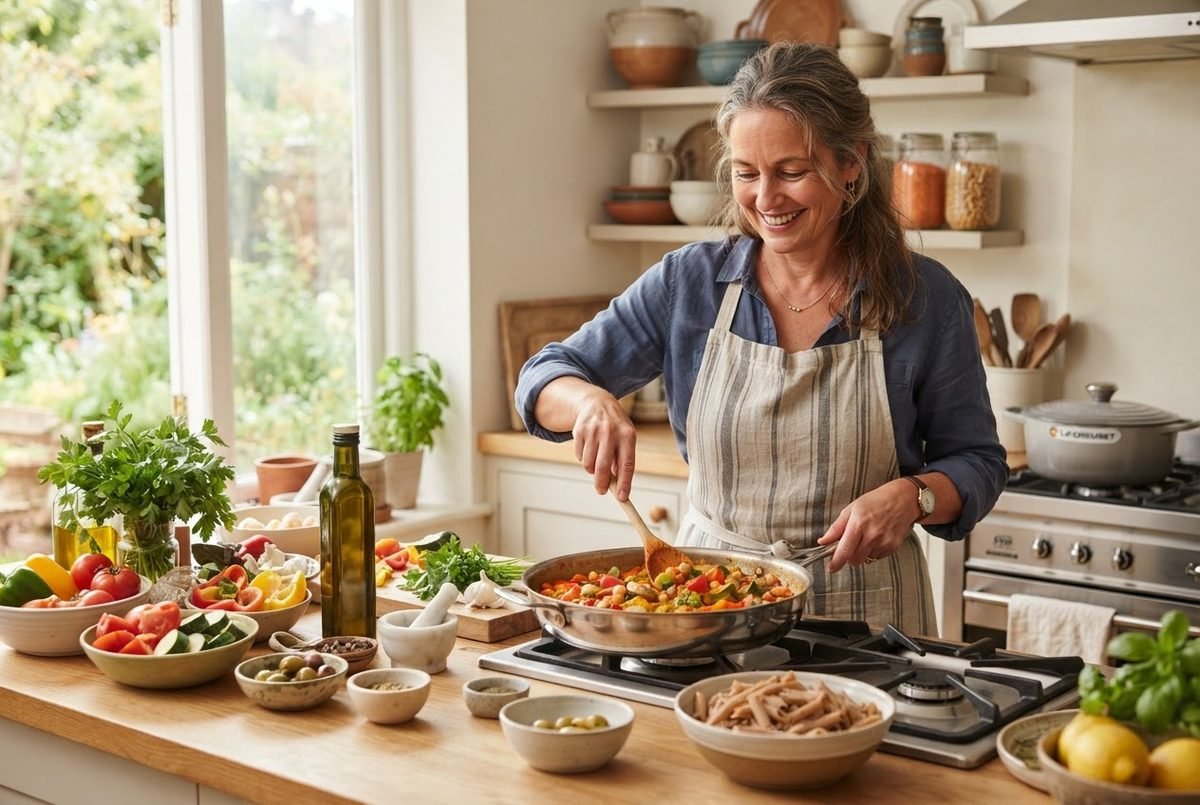
Cleveland Clinic describes the Mediterranean pattern as one that emphasises plant-based foods and healthy fats, with extra virgin olive oil as the main source of fat [4]. In practice that means plenty of vegetables, fruit, beans, lentils and nuts, a good amount of whole grains, a good amount of fish, especially oily fish rich in omega-3 fatty acids, and moderate amounts of natural cheese and yogurt. Red meat, sweets, sugary drinks and butter sit at the edges [4].
If you are building a mediteranian diet for menoapuse, Cleveland Clinic’s women’s health specialist Lynn Pattimakiel, MD, recommends a mix of vegetables, protein and calcium, and names the Mediterranean diet as a good all-in-one plan built on lean proteins, whole grains and plant foods [3]. Calcium earns its place because falling estrogen levels can affect bone and muscle mass [3]. Yogurt, tinned sardines or salmon with the bones, almonds and dark leafy greens all help.
If you want a shopping list rather than a lecture, this Mediterranean anti-inflammatory diet food list is a sensible place to start.

5 tips for a mediteranian diet for menoapuse
- Swap one sweet drink a day for water or sparkling water. Under 250 ml of sugar-sweetened drinks daily was the level linked to fewer joint and muscle complaints [1].
- Put legumes on the menu three times a week: lentil soup, chickpeas through a salad, white beans on toast. That pattern was linked to better physical function scores [1].
- Keep red and processed meat to one serve a day or less, and let fish, chicken or beans take the middle of the plate [1].
- Make extra virgin olive oil your everyday fat, in cooking and poured over vegetables [4].
- Add a calcium source to two meals a day, such as yogurt at breakfast and tinned fish or a small piece of cheese later [3].
None of that is dramatic, and that is the point. Small swaps you repeat beat a strict plan you abandon in a fortnight.
Drinks, portions and real life
Alcohol is worth a hard look. The British Nutrition Foundation says alcohol is known to trigger menopause symptoms such as hot flushes, night sweats and headaches, and advises no more than 14 units a week with several alcohol-free days [2]. Caffeine gets a mention too: limit caffeinated drinks or choose decaffeinated versions and herbal infusions, and keep caffeine away from bedtime because it can affect sleep [2]. Spicy foods trigger symptoms for some women, so it is worth testing rather than assuming [2]. If coffee is one of your pleasures, my Mediterranean diet coffee guide covers cups and add-ins without asking you to give it up.
Portions matter more than most of us admit, and a mediteranian diet for menoapuse is no exception, partly because metabolism shifts [3]. A rough guide to how much of each food group makes up a day is in this servings per day chart, which is easier to follow than counting calories.
Budget is the other real-life factor. Tinned fish, dried lentils, frozen vegetables, oats, eggs and plain yogurt do the heavy lifting for very little money, and they are exactly the foods this pattern is built on [4]. If you want meals that fill you up without feeling like a diet, these filling Mediterranean weight loss recipes are a fair place to look.
One last thing from Cleveland Clinic: do not push your body too hard with extreme diets. “We want to be realistic about what is sustainable long term,” Dr Pattimakiel says [3].
Related reading
- Your Mediterranean Anti Inflammatory Diet Food List: A plain shopping list to build your meals from.
- Your Mediterranean Diet Coffee Guide: Cups and Add-Ins: How to keep coffee without upsetting symptoms.
- How Many Mediterranean Diet Servings Per Day? A Clear Chart: A simple chart for portion sizes, no calorie counting.
- Mediterranean Weight Loss Recipes: 7 Filling Meals That Do Not Feel Like Dieting: Filling meals that do not feel like a diet.
Frequently asked questions
Will a mediteranian diet for menoapuse stop hot flushes?
The evidence is limited rather than settled. The British Nutrition Foundation says a Mediterranean-style diet may help some short-term symptoms such as hot flushes and night sweats, but the evidence is not strong [2]. A 2024 Australian study found no link with overall symptom severity [1].
Do I have to give up red meat?
No. The Australian study linked one serve a day or less with better general health scores, not zero [1]. Cleveland Clinic advises little or no red meat, choosing poultry, fish or beans instead [4].
Is dairy allowed on this plan?
Yes, in moderation. Cleveland Clinic lists a moderate amount of natural cheese and yogurt [4], and calcium-rich foods are recommended around menopause because falling estrogen levels can affect bone and muscle mass [3].
What about wine with dinner?
Cleveland Clinic allows a moderate amount of wine with meals, but adds that if you do not already drink, do not start [4]. The British Nutrition Foundation advises no more than 14 units a week with several alcohol-free days [2].
Can I keep drinking coffee?
Yes, with care. The British Nutrition Foundation suggests limiting caffeinated drinks or choosing decaffeinated versions and herbal infusions, and avoiding caffeine close to bedtime because it may affect sleep [2].
How much olive oil is too much?
Cleveland Clinic names extra virgin olive oil as the main fat source in this pattern, used in place of butter and other solid fats [4]. There is no single number; pour it over vegetables and use it for cooking.
Honest take
If you are looking for a mediteranian diet for menoapuse that erases menopause, this is not it, and anyone who tells you otherwise is guessing. What I would do, and what I would suggest to a friend, is treat the Mediterranean pattern as a steady background for the years around menopause: more plants, olive oil instead of butter, fish and beans instead of daily red meat, less sugar in drinks, and a sensible eye on alcohol and caffeine. That is worth doing for the long haul. This article is general information, not medical advice, so talk to your own doctor or dietitian about your situation, especially if you take medication or have a health condition.
References
- European Journal of Nutrition. Adherence to a Mediterranean-style diet and severity of menopausal symptoms in perimenopausal and menopausal women from Australia: a cross-sectional analysis. 2024. https://pmc.ncbi.nlm.nih.gov/articles/PMC11490460/
- British Nutrition Foundation. Managing menopause symptoms with nutrition and diet. https://www.nutrition.org.uk/nutrition-for/women/menopause/managing-menopause-symptoms-with-nutrition-and-diet/
- Cleveland Clinic. Menopause Diet: What to Eat to Help Manage Symptoms. 2022. https://health.clevelandclinic.org/menopause-diet
- Cleveland Clinic. Mediterranean Diet: Food List & Meal Plan. Updated 2024. https://my.clevelandclinic.org/health/articles/16037-mediterranean-diet
Get well and stay well,
Ray Baker
